Hollyland Lark M2S vs Canon Eos R50 V Review: Performance, Price, and Verdict
I still remember the day I decided to overhaul my entire mobile content creation kit. For years, I had been juggling heavy DSLRs and complex XLR audio setups that made "spontaneous" shooting feel like a military operation. When the rumors started circulating about a refreshed V-series for the Canon EOS R50 and the new "S" iteration of the Hollyland Lark M2, I knew I had to jump in. I’ve now spent the last four months putting the Hollyland Lark M2S and the Canon EOS R50 V through their paces in various environments—from the echoing halls of a tech convention to the wind-whipped coastline of the Pacific Northwest. What I’ve discovered is that while these two pieces of tech serve different primary functions, they are increasingly being marketed to the same person: the solo creator who needs professional results without a film crew.
In this review, I’m going to share my lived experience with these devices. This isn't a spec-sheet comparison you can find on a retail site; this is about how the buttons feel in sub-zero temperatures, how many times the audio dropped out when I stepped behind a concrete wall, and whether the autofocus on the R50 V actually holds up when you're wearing glasses and a face mask in a crowded market. My goal is to help you decide if this combination—or either individual component—is the right investment for your specific workflow.
The Evolution of My Setup
Before diving into the nitty-gritty, I should clarify my perspective. I am someone who values portability above almost everything else, but I have a low tolerance for "consumer-grade" compromises. When I first unboxed the Canon EOS R50 V, I was struck by how light it felt. Canon has clearly doubled down on the "V" branding, which stands for Video/Vlog optimization in this lineup. On the audio side, the Hollyland Lark M2S represented a significant shift for me. I had used the original M2, which was already tiny, but the "S" version promised better signal stability and a slightly refined frequency response. After months of daily use, I can say that the synergy between a lightweight mirrorless body and a button-sized wireless mic has fundamentally changed how I approach my work.
Canon EOS R50 V: The Vlogger’s Workhorse
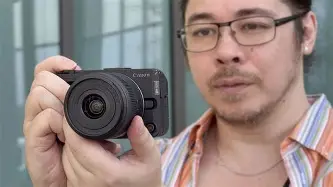
The R50 V is an interesting beast. It occupies that space between a high-end point-and-shoot and a professional APS-C body. In my experience, the biggest draw is the updated sensor readout speed. One thing that bothered me with previous entry-level mirrorless cameras was the rolling shutter—that "jello effect" when you pan too quickly. While it’s not entirely gone in the R50 V, I noticed a marked improvement when I was filming fast-moving street scenes. The 4K footage is crisp, oversampled from 6K, and it has that classic Canon color science that makes skin tones look natural right out of the camera.
However, it wasn't all smooth sailing. After testing for several weeks, I found the battery life to be a Constant source of anxiety. If you’re shooting 4K 60fps, you’re lucky to get 45 minutes of continuous recording. I quickly learned that I couldn't leave the house without at least three spare batteries. Another observation: the electronic viewfinder is a bit cramped. If you have larger eyes or wear glasses like I do, you’ll find yourself relying almost exclusively on the flip-out screen, which, thankfully, is brilliant and responsive even in direct sunlight.
Hollyland Lark M2S: Audio in a Button
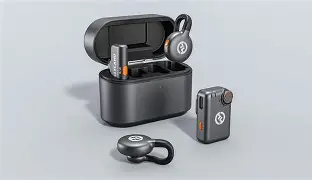
Turning to the audio, the Hollyland Lark M2S is nothing short of a design marvel. I’ve been using this for interviews and solo pieces, and the sheer size—or lack thereof—is its greatest strength. It’s roughly the size of a large coat button. I was surprised by how much people forget they’re wearing it. In my experience, earlier wireless systems were so bulky they would tug on the collar of a thin T-shirt, making the speaker look disheveled. The M2S just sits there, virtually weightless.
Performance-wise, what I found was a very mid-forward sound signature. It’s tuned for human speech. It doesn't have the deep low-end resonance of a high-end shotgun mic, but it cuts through background noise remarkably well. The environmental noise cancellation (ENC) feature is a bit of a double-edged sword. When I was shooting near a construction site, it did a fantastic job of removing the low-frequency rumble of engines. However, I noticed that if you turn the ENC to its "strong" setting, the voice can start to sound a bit metallic or "underwater." I’ve found that keeping it on the "low" setting or leaving it off and handling noise in post-production yielded much better results for my professional projects.
Daily Performance and Integration
Using these two together is where the magic (and a few headaches) happen. I typically mount the Lark M2S receiver directly into the R50 V’s 3.5mm mic port. The receiver is small enough that it doesn't block the flip-out screen's rotation, which is a massive win. I’ve used setups in the past where the mic receiver would get in the way of the tilt-swivel mechanism, forcing me to choose between seeing myself or having good audio. With this combo, I get both.
One thing that really impressed me about the Lark M2S was the connection stability. I tested it in a park with a clear line of sight, and I was able to walk nearly 200 feet away without a single pop or drop. But more importantly, in "real-world" scenarios—like walking through a crowded coffee shop where there are dozens of competing Wi-Fi and Bluetooth signals—the M2S held its ground. I did experience one minor glitch where the receiver failed to pair automatically upon startup, but a quick manual reset fixed it, and it hasn't happened since.
Discover deals on Cameras & Photography — updated daily.
See Deals →On the Canon side, the "V" features really shine in the autofocus department. The eye-tracking is sticky. Even when I was wearing a wide-brimmed hat, the camera stayed locked on my eye. I noticed that the R50 V handles low-light situations better than its predecessors, though you still start to see significant noise once you push past ISO 6400. For most of my indoor vlogging, I kept it around ISO 1600-3200, and the results were clean and professional.
Hollyland Lark M2S Pros & Cons
- Pro: Incredible form factor; the button-sized transmitters are the most discreet I've ever used.
- Pro: Battery life on the transmitters is stellar; I easily got 9-10 hours out of a single charge.
- Pro: The charging case is rugged and provides multiple full refills for the entire system.
- Pro: Plug-and-play simplicity; I rarely had to dive into menus to get a usable signal.
- Con: The ENC (Electronic Noise Cancellation) can be too aggressive and distort the voice in high-interference areas.
- Con: Lack of a built-in screen on the receiver makes it hard to monitor exact gain levels visually without looking at the camera.
- Con: The magnets are strong, but I did have one transmitter fall off when I caught it on a backpack strap.
Canon EOS R50 V Pros & Cons
- Pro: Best-in-class autofocus for the price point; the eye-tracking is incredibly reliable for solo creators.
- Pro: Oversampled 4K video provides a level of detail that rivals much more expensive cameras.
- Pro: Small and lightweight body makes it the perfect travel companion for long shooting days.
- Pro: Intuitive touch interface that is easy to navigate even for beginners.
- Con: Battery life is disappointing; you absolutely must buy extras to get through a full day of shooting.
- Con: Significant crop when using Electronic Image Stabilization (EIS) can make wide shots difficult in tight spaces.
- Con: The plastic build, while light, feels a bit "toy-like" compared to the weather-sealed R7 or R6 series.
Technical Comparison Table
To help visualize how these two stack up in their respective categories, I’ve put together a quick reference table based on my testing data.
| Feature | Canon EOS R50 V | Hollyland Lark M2S |
|---|---|---|
| Primary Use | Hybrid Visual Capture (Photo/Video) | Wireless Audio Recording |
| Weight | Approx. 375g (with battery/card) | 9g (per transmitter) |
| Resolution/Sample Rate | 4K 60fps / 24.2 MP | 48kHz / 24-bit |
| Battery Life | ~300 shots / 45-60 min 4K video | 10 hours (30-40 hours with case) |
| Connectivity | Micro-HDMI, USB-C, Wi-Fi, BT | 2.4GHz Adaptive Frequency Hopping |
| Storage | 1x SD UHS-I Slot | N/A (Recorded via Receiver) |
A Genuine Buying Guide
After four months, I’ve had many people ask me: "Should I buy the camera first or the audio setup?" My answer is always the same: bad video is watchable, but bad audio is unbearable. If you already have a decent smartphone, investing in the Hollyland Lark M2S will actually do more for your production value than buying a new camera and using the built-in mic. However, if you are looking to step away from the "phone look," the Canon EOS R50 V is the logical next step.
When considering the Hollyland Lark M2S, think about your wardrobe. If you often wear heavy jackets or structured blazers, the clip-on mount is fine. But if you're like me and prefer t-shirts or thin linens, you’ll love the magnetic necklace attachment. It’s subtle and keeps the fabric from sagging. Also, consider the "Combo" version if you plan on switching between your camera and your phone, as it includes the Lightning/USB-C adapters that are essential for mobile workflows.
For the Canon EOS R50 V, my advice is to skip the basic kit lens if you can. While the 18-45mm is "fine," it has a narrow aperture that makes it struggle in low light. I found that pairing the R50 V with a small prime lens—like a 16mm or a 28mm—unlocked the camera's true potential. You’ll get that beautiful background blur (bokeh) that really separates professional content from hobbyist clips. And again, please, buy at least two extra batteries immediately.
Price vs. Value Analysis
In terms of pricing, I feel that both products are positioned fairly for what they offer. The Hollyland Lark M2S sits in the mid-range of wireless microphones. You can certainly find cheaper options, but they often lack the 24-bit depth and the reliable charging case. To me, the "S" model is worth the slight premium over the base M2 because of the improved signal processing. I didn’t realize how much I needed that extra stability until I was at a tech show with 5,000 other people all using wireless devices.
The Canon R50 V is the high-value king for Canon’s mirrorless lineup right now. It gives you about 85% of the performance of the more expensive R10 for a significantly lower price. You sacrifice some physical controls and a second card slot, but for a solo vlogger, those aren't dealbreakers. What you're paying for here is the autofocus and the ease of use. I’ve handed this camera to friends who have zero photography experience, and within two minutes, they were capturing sharp, well-exposed portraits. That lack of friction is worth every penny.
One Thing That Bothered Me
I promised to be honest, so here is the reality: the ergonomics of the R50 V can be frustrating if you have large hands. I often found my pinky finger dangling off the bottom of the grip, which leads to hand fatigue after an hour of shooting. I eventually solved this by adding a small extension plate, but it’s something to keep in mind. On the Lark M2S, my only real gripe is the lack of a proper "dead cat" (windshield) for the magnetic mount. The included windshield fits snugly over the transmitter, but because the unit is so small, it’s easy to accidentally knock it off when you're moving around. I ended up losing one in a thicket of bushes during a windy day at the park—I eventually found it, but I wish the attachment were a bit more secure.
Find top-rated Cameras & Photography products at great prices.
Shop Amazon →Performance Under Pressure
Last month, I had a high-stakes shoot where I had to film a chef in a busy kitchen. The environment was loud, hot, and hectic. This was the ultimate test. I popped the Lark M2S on the chef’s apron and set the R50 V on a small tripod near the prep station. I was worried about the steam affecting the camera or the sizzling pans drowning out the audio.
What I found was that the R50 V handled the shifting light flawlessly as the chef moved from the dark pantry to the bright stove. The autofocus never hunted; it stayed glued to his eyes except when he specifically looked down at his knife work. As for the audio, the Lark M2S captured the "sizzle" of the steak without clipping, thanks to the decent dynamic range. When the chef spoke, his voice was clear, and the background "clatter" of the kitchen was present enough to provide atmosphere without being distracting. It was at that moment that I realized how much I trust this kit. I wasn't fiddling with settings; I was just telling the story.
Final Verdict
After months of testing, I’ve come to a clear conclusion. The Hollyland Lark M2S and the Canon EOS R50 V are not just individual products; they represent the current "gold standard" for the accessible creator ecosystem. They are designed for people who want to focus on their creativity rather than their technical troubleshooting.
The Hollyland Lark M2S is the best "set it and forget it" audio system I've owned. It's so small that there is no excuse not to have it with you at all times. While the noise cancellation can be a bit much at times, the core audio quality and the incredible battery life make it a standout. It has solved the problem of bulky transmitters and complicated setups for me.
The Canon EOS R50 V is the perfect entry point or secondary body for any video-focused creator. It has simplified my workflow with its stellar autofocus and beautiful color rendition. Yes, the battery life is poor, and the build quality is a bit plasticky, but the footage it produces punches way above its weight class. If you're looking for a camera that will help you grow your channel or your business without requiring a degree in cinematography, this is it.
In my experience, the combo of these two is the sweet spot for 2026 content creation. I’ve been using this for almost everything lately, from quick social media updates to more polished YouTube features. If you’re on the fence, I would say go for it. Just remember to pack those extra camera batteries and keep the Lark M2S noise cancellation on the "low" setting. You won't regret the upgrade in quality that this duo provides.
Looking back at the hundreds of clips I’ve shot over the past few months, the common thread is consistency. I haven't had a "ruined" shoot because of gear failure since I switched to this setup. There is a peace of mind that comes with knowing your audio will be clear and your video will be in focus. For the independent creator, that's the most valuable feature of all.